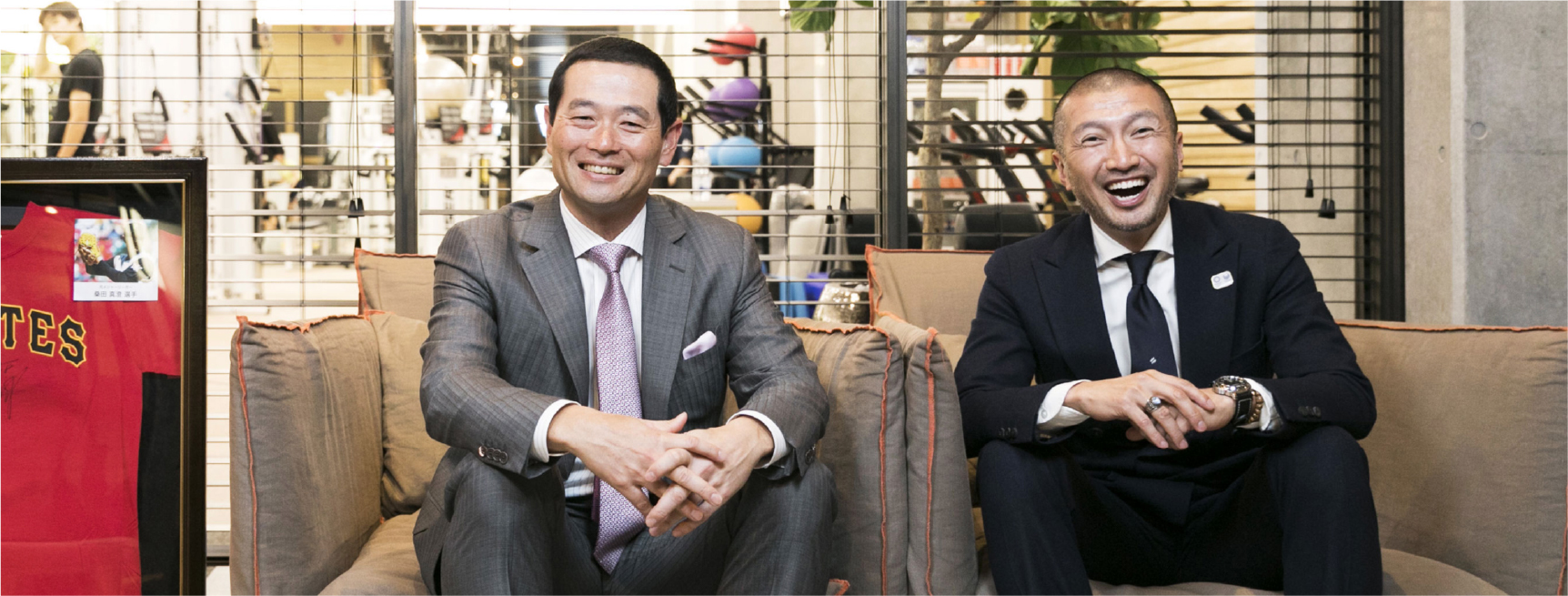
In-Depth Conditioning Discussion No.04To avoid going down a rabbit hole.
Yuji Naito x Takeshi Suzuki (R-body)
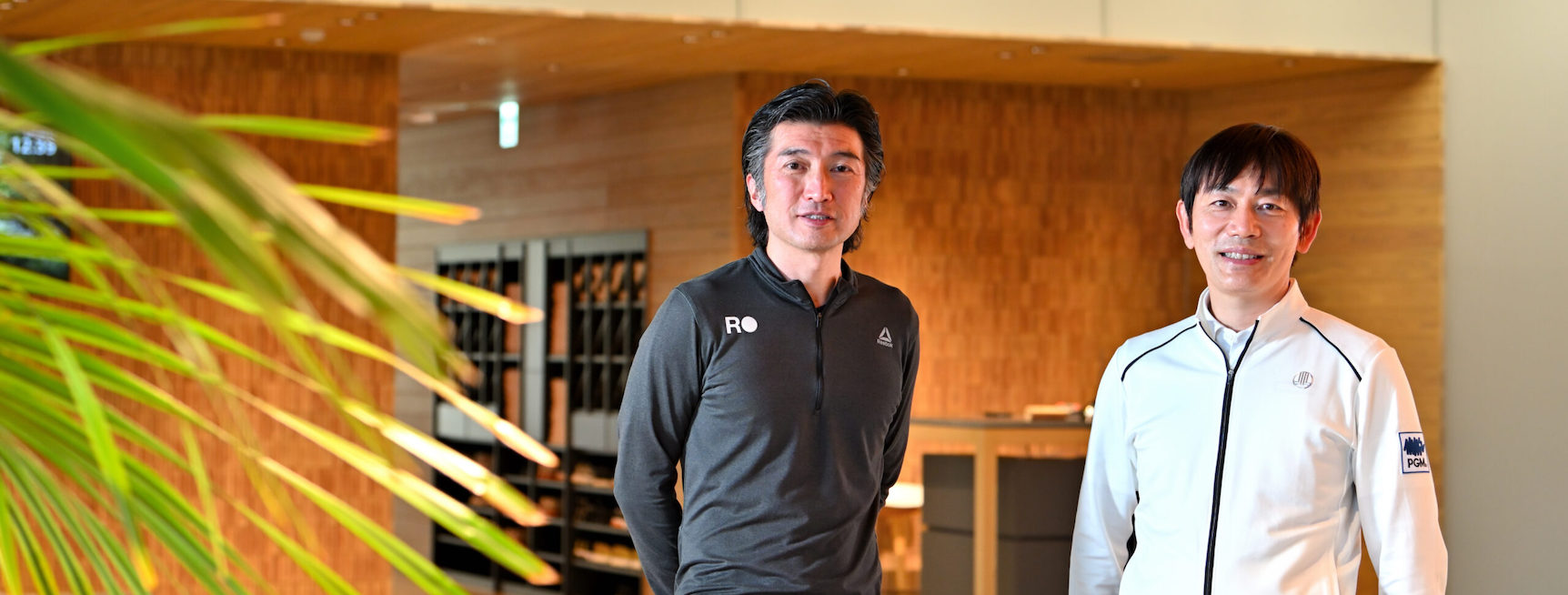
As a coach for professional golfers, an instructional programs host, TV commentator, creator of a YouTube channel, and writer for magazines and books, Yuji Naito is in high demand. Amidst his busy schedule, he always found time to squeeze in golf practice sessions, but suddenly found he couldn't hit the ball as far as he used to. Even after making time for extra practice, he couldn't solve it. "Huh? What's going on?", he thought, "This has never happened before." That's when he came across conditioning training, and in the seven years since, he's been working on getting his body in better physical condition. "Lately, I've become able to expect a lot more from myself", he says. We sit down to chat with one of golf's foremost theorists about the relationship between golf and conditioning training.
* This conversation took place in March, 2022 at Mitsui Garden Hotel in Kashiwa-no-Ha.
Naito : A person at the sports center I used to visit said to me, “I know of this really amazing trainer - why don't you make an appointment to see him?” And that's how I was introduced to you, Takeshi. At the time, I remember I was penning an interview column in a magazine called Golf Today, and by asking you to appear in it together, we developed a close relationship.
Suzuki : That was about eight years ago, right?
Naito : Yes. The stuff you talked about at the time was fascinating, and since it all made perfect sense, I decided to join R-body immediately. I started as a member at the Ebisu branch and now go to the Otemachi branch. I haven't been to the branch here in Kashiwanoha yet, but I know there's a fantastic golf course nearby, and the transportation network is good, plus the area is becoming more and more developed. It's actually a neighborhood I've thought about moving into, especially as I have friends who live nearby as well.
Suzuki : Golf is such an interesting sport. For example, what are the fundamentals of a powerful golf swing? How should the body move? I like the way you teach your clients about those things. During that magazine interview you mentioned earlier, what you discussed wasn't concerned with the latest fads or trendy coaching techniques. Instead, it was grounded in the fundamentals, almost the same style we athletic trainers use when teaching exercises to enhance functional movements. While there are certain variables like the grass conditions and weather, golf is essentially a sport where you hit a stationary ball without a direct opponent. Therefore, improving your own physical function can directly impact your golf performance. I distinctly remember listening to what you said at the time and thinking, "That totally makes sense."
“Your physical condition = Your golf form”
Naito : It's been about seven years since I started learning about how the body works and the impact on physical movement, but I still feel like I'm only halfway there. Today, I'd also like to learn a lot from everyone here in the venue, too. Actually, before coming here today, I was working on commentary until the early hours of the morning. When I get busy like that, I end up doing a lot of desk work, like preparing materials and leaning forward to look at the computer screen. That invariably leads to poor posture. And when that happens, I can't swing the club the way I want to, and even if I go to R-body for a conditioning session, my body just won't move properly for some reason. It really drives home how your physical condition basically equals how your golf form is at any given moment.
Suzuki : What kind of problems do you encounter?
Naito : The back of my thighs, the hamstring muscles, tend to get really tight.
Suzuki : When hamstring flexibility is compromised, it becomes harder to properly hinge at the hips and maintain a forward tilt with a straight spine.
Naito : Exactly. You end up slightly hunched over, with your knees sticking out. If I'm teaching a client and see bad posture, I will focus on correcting that first. The trouble is that you can't see your own swing, so for myself I only realize when I watch it back on video. Ideally, I want to keep my hips in good position and maintain the correct forward tilt throughout a whole round of golf. But when work piles up, it becomes hard to do that, especially when you get fatigued near the end of the round.
“Everyone in attendance today, I apologize, but could you please stand up?”
Takeshi Suzuki's voice resonates around the conference room at the elegant Mitsui Garden Hotel in Kashiwanoha, located just a 60-second walk from the Kashiwanoha-Campus Station on the Tsukuba Express Line.
“Please place your right palm on the back of your head and your left palm on your lower back. Keep your chest out and your hands in an imaginary straight line. That's it. Now, from that position, tilt your body forward. Don't round your back or bend your knees. How far can you go?”
“Whoa!”, “Ooh!”, “Gosh, that's tough.” Exclamations of surprise spill out from the attendees at the venue.
“Some of you might be thinking, ‘It's just a forward bend - what does that have to do with golf?’ But as Mr. Naito mentioned earlier, the most fundamental aspect of golf is to maintain your forward tilt angle and rotate your body axis, without swaying from front-to-back or side-to-side. If this tilt isn't done correctly, it could mean that no matter what you do next, you're going to struggle to hit the ball well.”
Naito : Maintaining a stable axis and good forward tilt is fundamental for creating a good swing plane and correct clubface alignment, which are the crucial elements of the golf swing. As Mr. Suzuki mentioned earlier, golf is a sport where you move your body to strike a stationary ball. If you can't properly maintain that forward tilt, the club won't return to the ball on the correct line. A golf swing is made up of lots of movements from various parts of the body, but one of the most important areas to focus on is the range of motion in the thoracic spine and hips. This is an area I constantly focus on during my own training sessions at R-body. While my conditioning menu has changed and evolved since joining, I always make sure exercises targeting those two areas are included in my workout.
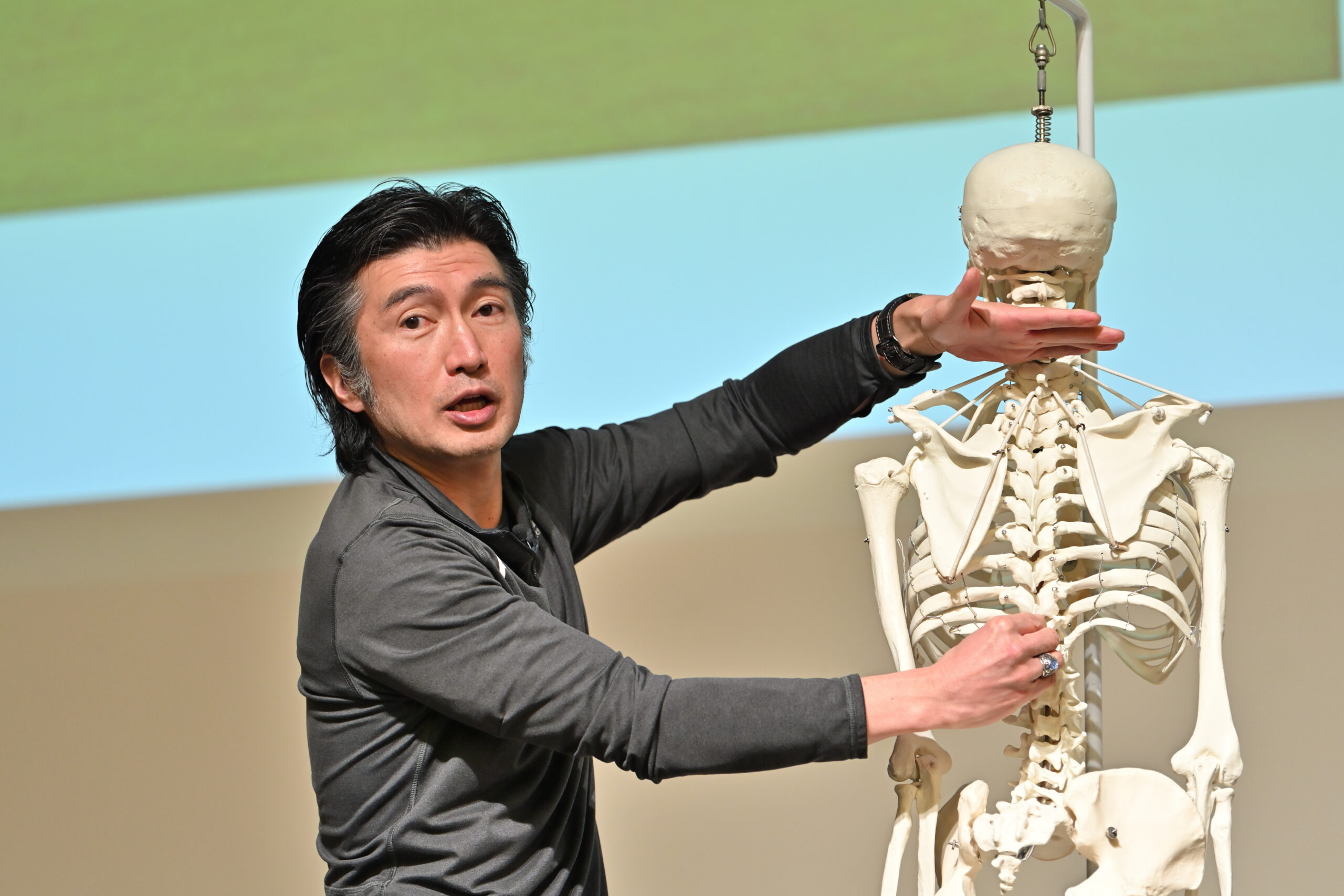
Suzuki : The spine is a basically a column of bones called vertebrae that are stacked on top of each other and run from your neck down to the area near your buttocks. The neck region is the cervical spine (7 vertebrae), and the middle section, which connects it to the lower back and where the rib cage attaches, is the thoracic spine (12 vertebrae). Meanwhile, the bottom section is called the lumbar spine (5 vertebrae). In golf, the thoracic spine is the part that moves the most and is critical for generating power through rotation.
“Symptomatic Treatment is the Entrance to a Rabbit Hole”
Naito : If someone doesn't have sufficient thoracic rotation, the clubhead tends to get ahead, resulting in symptoms like an extended elbow or chicken wing. When coaches see things like that, they tend to say, "Your elbow is coming up, so be sure to keep it down."
Suzuki : However, that's just symptomatic treatment. (Addressing the symptoms without curing the underlying cause)
Naito : Exactly. And if you try to correct it by, for example, wedging a headcover under your armpit, you often end up not being able to swing the club properly and lose distance entirely.
Suzuki : If the thoracic spine and hips aren't moving correctly, there's no way that the elbow will tuck in properly. On the other hand, if the body rotates correctly, the armpit won't tend to extend out excessively, right?
Naito : That's correct. While sometimes swing path or clubface alignment can be fixed through swing-based lessons at the range, if the root cause involves a lack of range of motion, then we need someone with your expertise to help fix the player's functional movement. What we need is to understand the correct swing method and theory, while simultaneously doing conditioning training to allow our bodies to actually make the correct movements. When these two overlap, a synergistic effect occurs, dramatically accelerating improvement through the combination of lessons and conditioning. I've experienced this myself.
Suzuki : The human body is basically designed to rotate up to about 100 degrees. 90 degrees plus a little extra is the normal range. To check your rotational capability, first place your hands on your hips and maintain a straight posture as if a pole were piercing you from the top of your head to the ground. Now, from that position twist your body without arching your back or bending your knees in the direction of rotation. Then check the orientation of your right shoulder and left shoulder. You should be able to create 50 degrees by rotating the thoracic spine. The remaining fifty degrees should be created by hip rotation. Visualizing it as half and half makes it easier to understand. If you can't reach close to 100 degrees, I think it's going to be hard to dramatically improve your swing no matter what you do.
Everyone, please try to sit in a way that you have good posture. It's fine to sit with your legs crossed. Is everyone in position? OK, now place your fingers on your solar plexus and navel. The solar plexus is roughly at the top of your lumbar spine, and the navel is at the bottom. Now, in that position, twist your body as hard as you can, then return to your original position and check the position of your fingers. Before twisting, your solar plexus and navel were aligned in a straight line. What happened? You'll likely find that even with a full twist, they only shift a few centimeters at most. If the golf backswing were created by twisting the waist, the finger positions should shift a lot more, but the body isn't built that way. You might hear phrases like "twist at the waist" or "turn your hips," but anatomically, the lumbar spine isn't structured to twist. The backswing isn't generated by the lumbar spine. So where is the rotational power primarily created? It's in the thoracic spine, the middle section between the lumbar spine and cervical spine.
Naito : I was surprised once to hear someone say, "For a good golf swing, all you need is good flexibility around the shoulder blades, isn't that right?" This was from a golf reporter with over 20 years of experience. I think that's also one of the common misconceptions. In order to rotate the thoracic spine efficiently, it is essential to properly stabilize the shoulder blades. This is also called 'shoulder packing'. This is especially important these days, in order to control modern drivers with their long shafts and large heads.
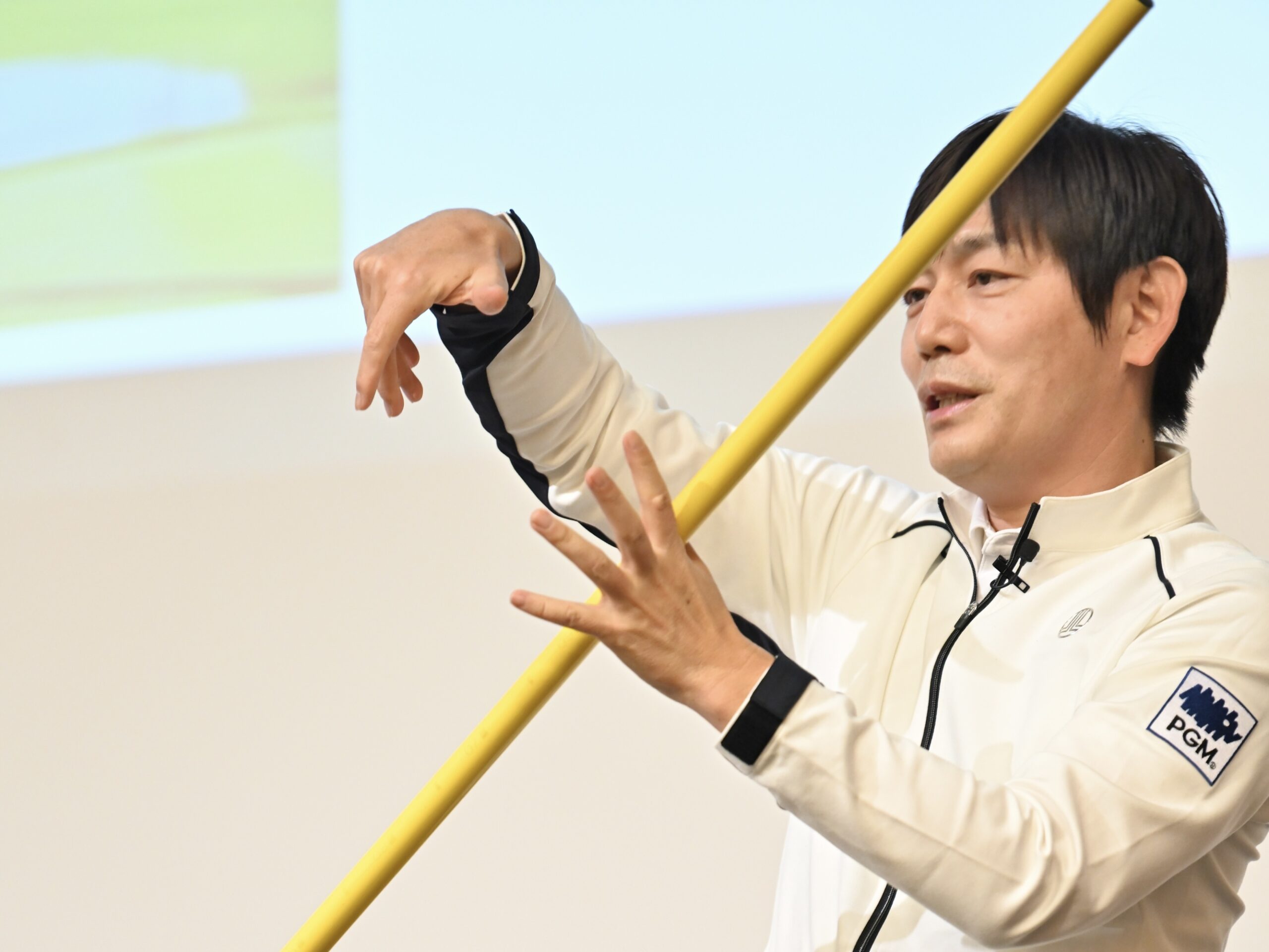
Suzuki : To understand shoulder packing, start by putting both hands out in front of you. Then, twist both palms outwards in a circular motion as far as you can. Hold that position and try to lower your shoulders as far as possible down and away from your ears. You should feel your shoulder blades drop and a distinct tension build in the area under your armpits. This is shoulder packing.
Naito : Now if you maintain that position, keeping the insides of both elbows pointing upwards, and bring your palms together to grip the club, you will be in the correct golf address.
"Golf where you are overly-conscious of your body's movements"
Suzuki : If you do the shoulder packing technique correctly, if after bringing your palms together you bend and straighten your elbows, your hands should move smoothly in front of your face. On the other hand, if your shoulder blades and elbows are too loose, your hands will move in various directions when you bend and straighten your elbows.
Naito : If you can get into the top of the backswing without the distance between your hands and shoulders lengthening or shortening, you can make a good impact just by dropping your right shoulder as you swing down. However, if you try to rotate the clubface a lot but you have loose shoulder packing, it tends to stay open and not return, leading to the ball going right. Or, if you try to force it back, it goes left instead.
Suzuki : The shoulder blades can also rotate. Try bringing your right shoulder blade forward and pulling your left shoulder blade back. Then do the opposite. This rotation is created solely by the shoulder blades. However, this rotation is extremely minimal. More importantly, once you have a club in your hands, it makes it impossible to do this movement, so you cannot swing using shoulder blade rotation alone. Therefore, the thoracic spine and hips, while not the only factors, are essential to the golf swing. Without movement in these two areas, you simply cannot execute a proper backswing. The club has a certain amount of weight to it, though, so the law of inertia comes into play, and this results in some scapular movement. Think of the thoracic spine as the primary driver of the movement, with the scapulae moving in response. That's how I tend to see their roles.
Naito : Yes. What you need to do is to pack the shoulder blades correctly and rotate the thoracic spine efficiently to reach the top of the swing. Then, with the hips firmly hinged and maintaining forward tilt, bring the clubhead down by rotating the waist. This creates an impact like striking a temple bell, making a solid thud, without the clubface wobbling. However, those whose thoracic spine doesn't move sufficiently often try to raise the club by moving something else instead, leading to you to get lost in a maze of frustration and go down a rabbit hole of misunderstanding.
Suzuki : Precise, repeatable rotational movements are the key to playing good, consistent golf - but it is also difficult to do. If your body lacks the function to rotate properly, you end up trying to hit the ball with all sorts of other movements. This causes malfunctions that pile up one on top of the other, leading you into that maze of frustration you just mentioned.
Naito : When there's a problem with the body's functional movement, I believe it's safe to say that technical symptomatic treatments rarely lead to a permanent solution. If you properly condition your body for golf, it will rotate efficiently and eliminate unnecessary movements. Your arms won't rise up awkwardly, and your elbows won't extend out in strange directions.
Suzuki : Another reason some players tend to get lost in a maze is from over thinking, or being overly conscious of their body's movements. For example, during a soccer match, you don't have time to consciously think about your shoulder blades, thoracic spine, or hips while kicking the ball. The game is so quick you have to almost play subconsciously and make split second decisions. But in golf, you have a lot of time to think. And many players actually do it. For instance, if you consciously try to brace your core at the start of your swing, then think about integrating your arms and upper body, and then try to maintain that awareness while tightening your abs and remembering to keep your hands soft, you will almost certainly end up overcomplicating things. This actually prevents you from swinging the club properly. Muscles can only generate power when they are able to switch between their "on and off" modes. So whilst being mindful of the initial movement can be good to start the swing sequence, after that prioritizing a smooth flow is more important. That's my perspective as an athletic trainer.
Here, we’ll introduce a thoracic rotation exercise that Mr. Naito often performs. First, place your left knee on the floor and extend your right leg forward so that you are kneeling on one leg. Next, put your left hand on the outside of your right knee, holding it in place, and put your right hand on the right side of your head, just behind your ear. From this position, rotate your body around to the right. Twist with all your might. This is the sensation of rotating your thoracic spine. When this is done with both knees free to move, people whose thoracic spine doesn't rotate will try to create the twist by turning their waist, but this isn't possible with one knee held firm. Another way to do this is to stand with your feet slightly apart to the front and back. Next, put your arms out in front of you and place a club in the palms of your hands. Then try to rotate your body from side to side. This is also a simple yet effective way to loosen up your thoracic spine before starting a round of golf.
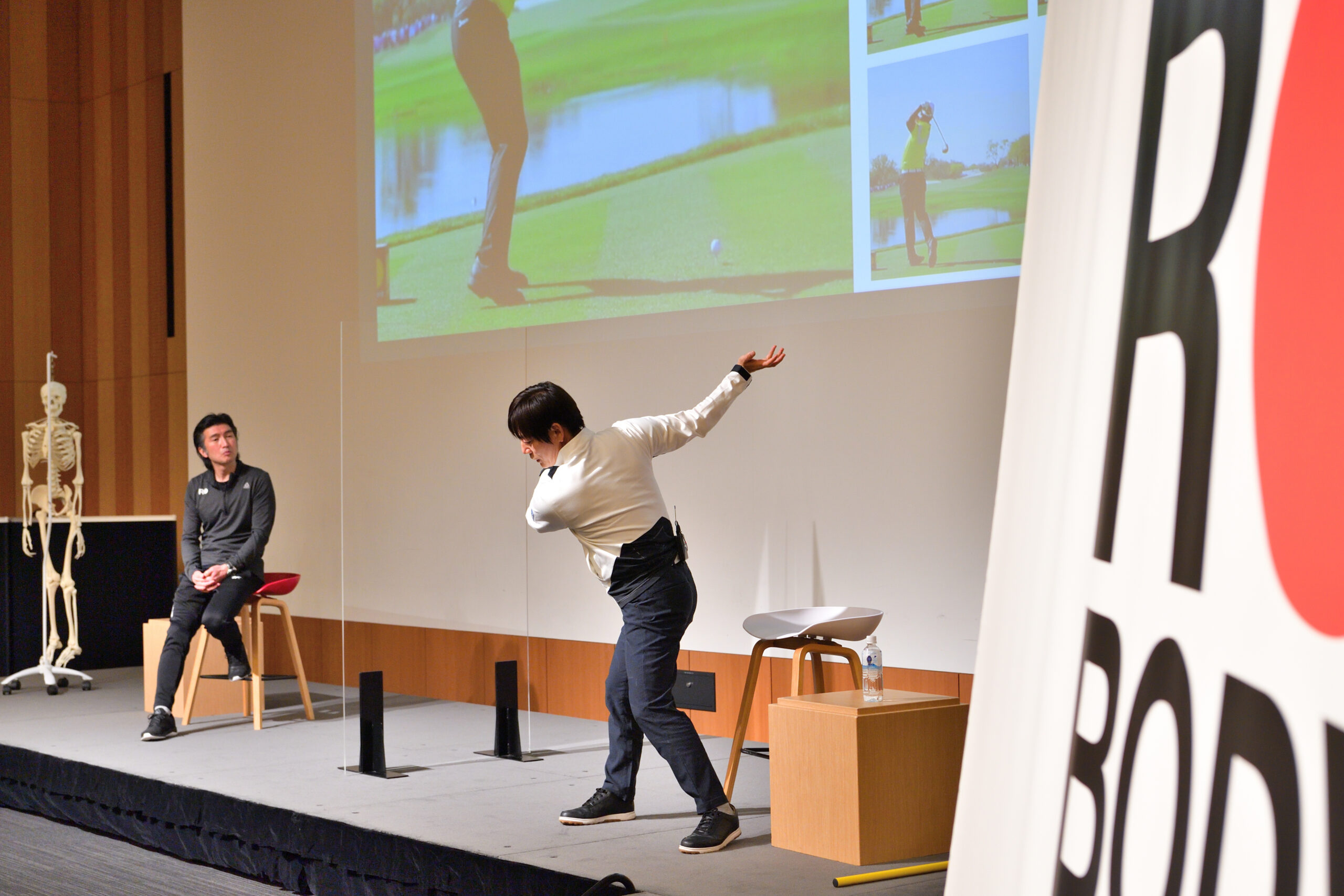
Naito : I started taking golf lessons at age 9. And then, having played competitively for many years and also studied the golf swing as a coach myself, I knew the fundamentals of how to swing a golf club. However, as I mentioned earlier, when I got busy at work, practice naturally took a back seat. And then when you add in the effects of getting older, I found that my body just wasn't able to move correctly anymore. When work finally slowed down and I had time to practice again, I practiced a lot, but I found that I still couldn't hit the ball properly at all. Huh? This had never happened to me before. It was during this period of frustration that I was introduced to yourself, Takeshi, and by training at R-body, I learned more and more about my body and how things worked. Then, by putting things into practice, I began to understand things like, “Oh, I have a restricted range of motion in this area,” or “I'm lacking strength in this part of my body.” Once I understood those things, it was just a matter of training my body to get into the proper condition. Even the most hard to pin down concerns have totally disappeared now.
Suzuki : If you wish to solve swing problems using a technical approach, then you first need the body to be functioning properly as a prerequisite. If the root cause of any swing issues lies in dysfunctional movement patterns, then no matter how much you refine your technique, you are unlikely to be able to consistently execute your perfect swing.
“Recently, I've come to expect great things of myself.”
Naito : When people coming to me and say, "I just can't seem to hit the ball properly. What should I do?", I want them to be able to tell me at the end of the lesson, "I can hit it much better now." I want them to leave feeling motivated and satisfied, but unfortunately I only have one hour at a time. So when tracing swing issues back to the root cause makes it difficult to reach the goal quickly, I inevitably end up pulling out quick fix advice like, "Your arms are too stiff when swinging, so try to keep them more supple." I think that such cases are not uncommon. However, no matter how short the time-frame, I've come to realize that if I don't conduct a lesson that firmly grasps the core issues, then it won't lead to progress next time. A lot of self-reflection has brought me to this point.
Suzuki : Nowadays, we have convenient tools like smartphones, so it's easy to check your own swing to an extent, but when it comes to checking your functional movement it is not that simple. Of course, if you have some pain, then you know something's wrong, but a lot of the time you might not have any obvious symptoms related to your dysfunctional movements. Earlier, we had everyone do the thoracic rotation exercise, and quite a few people had a surprised look on their face like, “Oh. I can't twist as much as I thought.” You only become aware of your own dysfunction when you actually try these kind of exercises.
Naito : I've learned this the hard way myself. Checking your body's functional movement is impossible without expert help. You also need to understand your own body, and understand the theory and training techniques. When you have an understanding of both, a synergistic effect kicks in, and you not only improve at a much faster rate, but you also become less prone to getting into bad habits or getting injured. If I had time, I would go to R-body every day so that I could become able to move my body exactly how I want to. And on top of that I would like to also increase both my practice volume and the number of rounds I play. Through this combination of conditioning training and practice, recently I've come to expect great things of myself. To that end, I encourage everyone to please check your body's functional movement, to find out your current condition. This is something that I sincerely recommend doing.

YUJI NAITO
Japan PGA Teaching Professional.
As a student, and while a member of the Nihon University golf club, he studied abroad in the United States to learn about the latest golf theory and techniques.
After returning to Japan, he established the Learning Golf Club at the Highland Center practice facility in Tokyo and began his coaching career.
In 1998, he began working as a tour pro coach.
He has helped many clients to victories on the professional golf tour, including Shigeki Maruyama's three PGA Tour wins.
Currently, in addition to his ongoing work as a Japan PGA Teaching Professional, he appears on various types of golf media channels, including as a commentator for the PGA Tour, and also serves as a director for the Shigeki Maruyama Junior Foundation, which focuses on developing junior golfers.
SPECIAL TALK SESSION
-
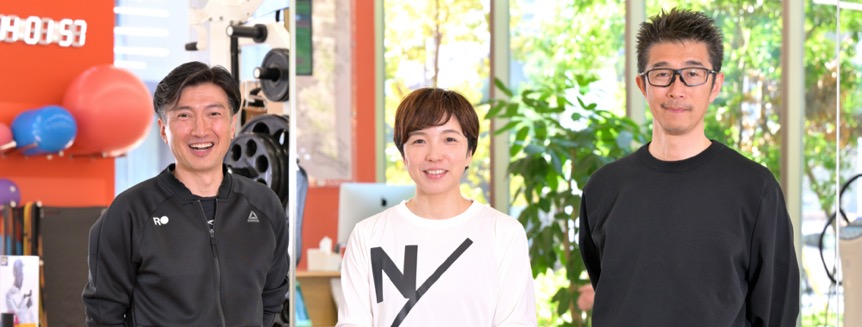
No.06With this body gifted to me by my parents, I want to make the most of my life
Nao Kodaira x Masahiro Yuki x Takeshi Suzuki. (R-body)
-
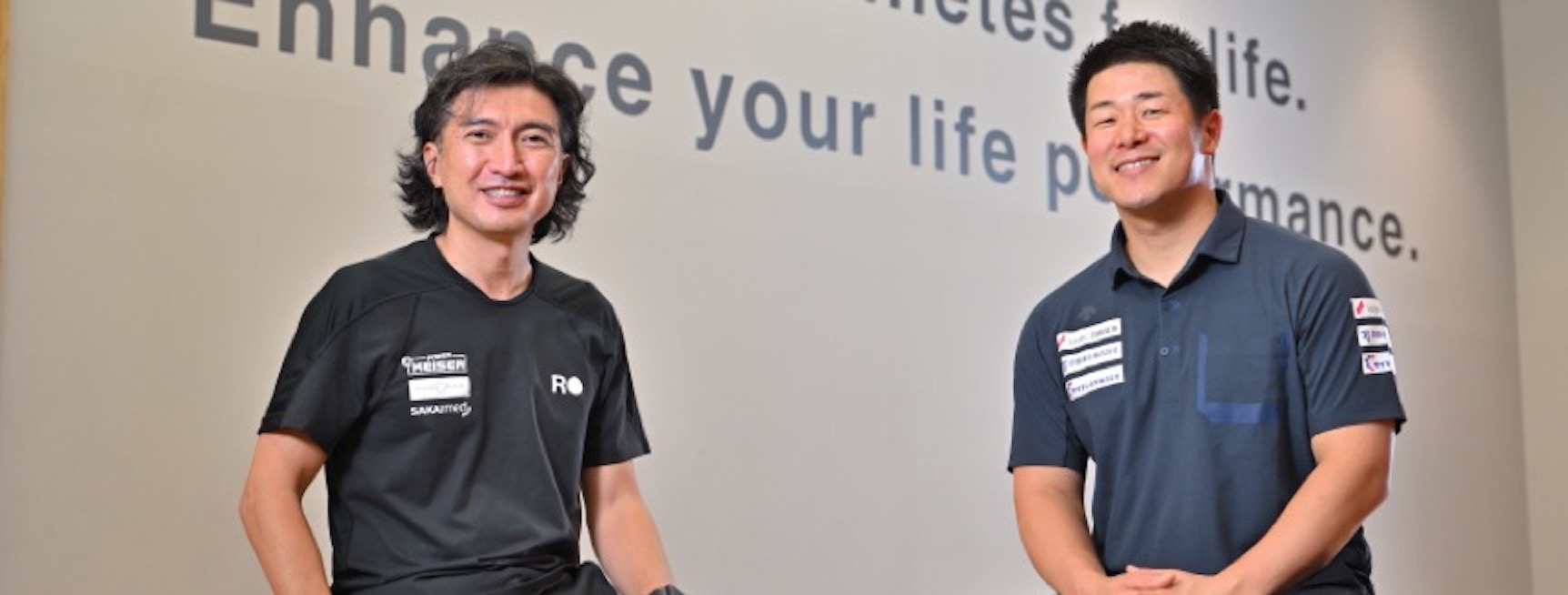
No.0515cm of Infinite Potential.
Hiraku Misawa x Takeshi Suzuki. (R-body)
-
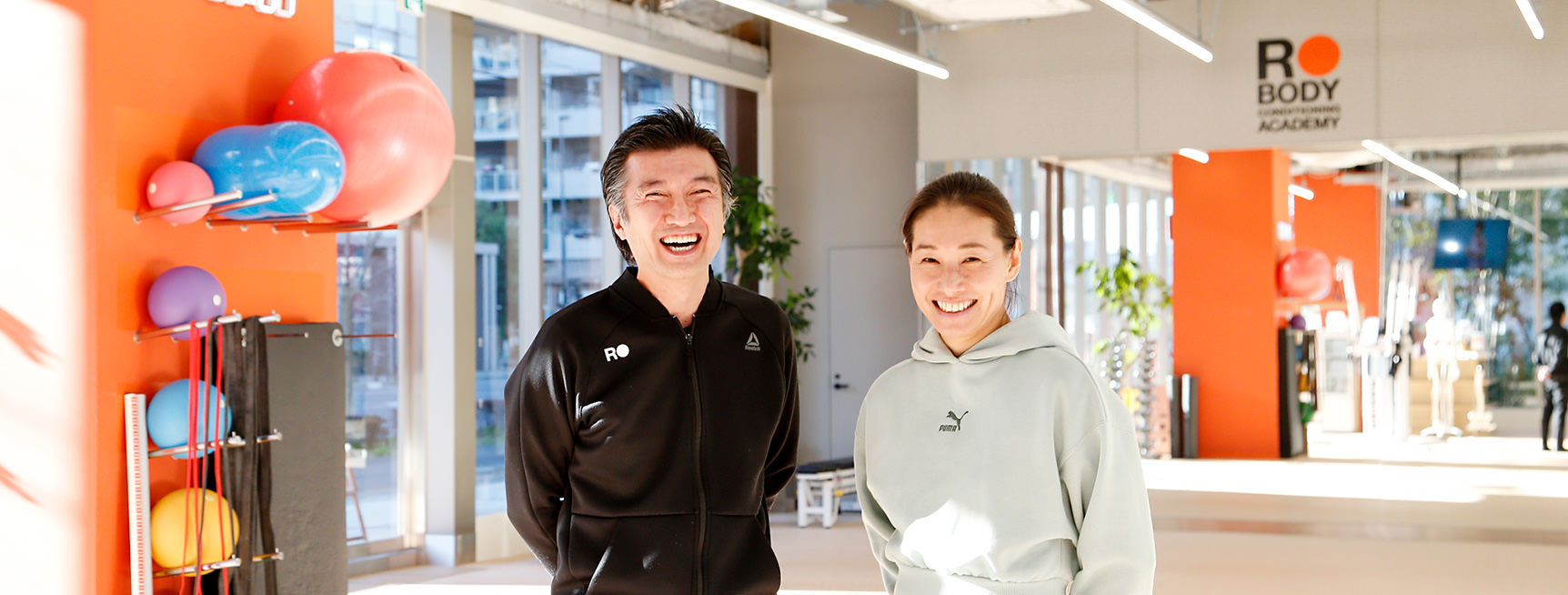
No.03Living healthily until 100 years old
Kimiko Date x Takeshi Suzuki (R-body)
-
No.02Raising the Profile of Japanese Athletic Trainers
Kosuke Kitajima x Takeshi Suzuki. (R-body)
-
No.01Getting to Know Your Own Body
Masumi Kuwata x Takeshi Suzuki. (R-body)